

From Chatbots and IVR to Expressive AI Voice Agents
For business leaders navigating today’s customer experience landscape, AI in the contact center is no longer a future concept. It is an operational decision with real consequences. The question is no longer if you should deploy digital agents, but how to do it without damaging customer trust, agent morale, or operational stability.
At Humach, we have seen what happens when AI is rushed into production and what happens when it is implemented the right way. Moving beyond legacy chatbots and IVR systems to digital voice agents with expressive, emotionally intelligent voices built for real customer conversations is not about replacing humans. It is about designing intelligent digital agents that work alongside your people, systems, and data to deliver measurable business outcomes.
Unlike traditional text-to-speech systems, today’s digital voice agents can dynamically adjust tone, pacing, and emotion in real time. This enables de-escalation, reassurance, and natural conversational flow in moments that matter most. Advances in expressive voice technology, such as ElevenLabs, have made human-like voice interactions production-ready for modern contact centers.
This evolution reflects a shift toward operational AI that must perform reliably in real customer conversations across voice and digital channels.
The Digital Agent Evolution: What Has Actually Changed
Early digital agents promised efficiency but often delivered frustration. Many were limited to simple scripts and brittle decision trees that broke down when conversations deviated from expectations.
Modern digital agents are fundamentally different, not because of marketing hype, but because of how they are built, trained, and governed.
Today’s digital agents are:
- Context-aware, carrying conversation history across systems and channels
- Emotionally intelligent, adapting responses based on tone, urgency, and sentiment
- Transaction-capable, completing workflows end to end rather than deflecting tasks
- Human-supervised, continuously improved by trained experts using real interactions
The evolution of digital agents is not just technological. It is operational.
From Legacy Chatbots and IVR to Enterprise Digital Voice Agents
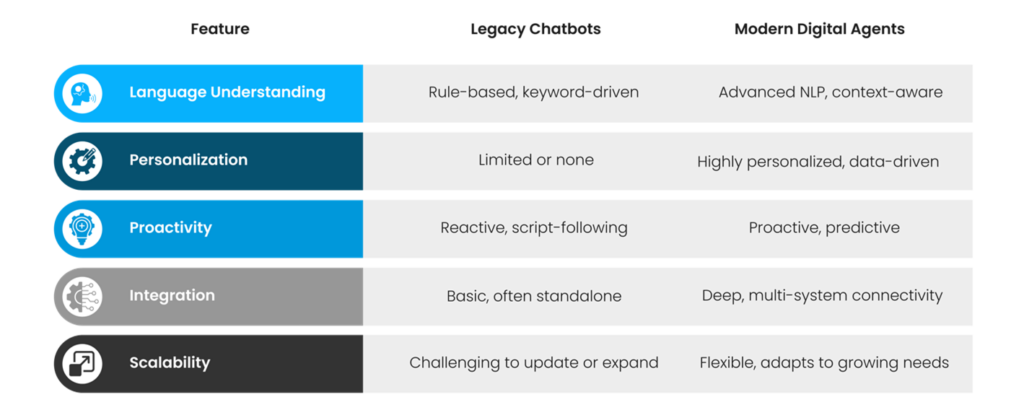
Legacy chatbots, popularized in the early 2000s and 2010s, were groundbreaking but limited. They proved AI could reduce human workload but couldn’t meet today’s demands. They relied on rigid scripts, menu trees, and keyword matching. When customers followed the happy path, these systems worked. When they did not, frustration followed.
Modern digital voice agents operate differently. They are designed for natural conversation and real-world contact center conditions.
Key differences include:
- Training on enterprise-specific knowledge instead of generic scripts
- Deep integration with CRMs, billing systems, CCaaS platforms, and APIs
- Seamless escalation to human agents without losing conversation context
- Consistent experiences across voice, chat, SMS, and digital channels
Most importantly, digital voice agents are built to sound human, respond with empathy, and act as true extensions of your brand.
Key Differences: A Quick Comparison
The Real Challenges of Implementing AI in the Contact Center
AI success is rarely blocked by technology alone. It is most often blocked by execution. Organizations that struggle with digital agents typically face one or more of the following challenges.
Poor Data Readiness
If your knowledge base is fragmented, outdated, or undocumented, AI will amplify those gaps. Digital agents require clear intents, accurate policies, and reliable access to live systems.
Lack of Human Oversight
Fully autonomous AI without human-in-the-loop governance increases brand risk, bias exposure, and customer dissatisfaction. High-performing digital agents are continuously trained and refined by experts who understand real customer behavior.
Broken Escalations
Few experiences damage trust faster than forcing customers to repeat themselves. Without proper context carryover between AI and human agents, containment quickly turns into abandonment.
Channel Fragmentation
Customers do not separate voice from chat or SMS. AI strategies that focus on a single channel create inconsistent experiences and incomplete data.
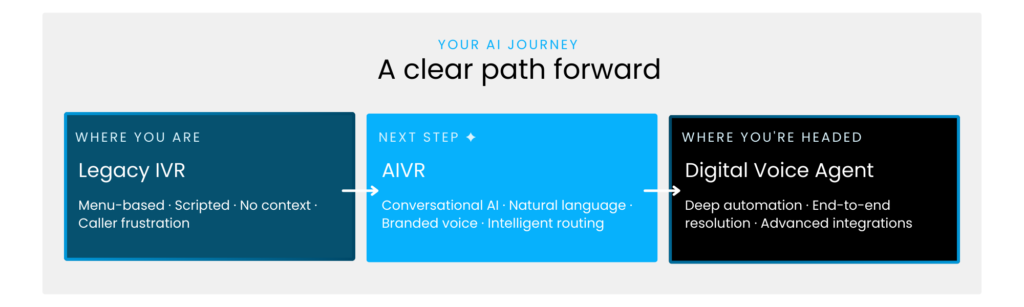
A Proven Path to Digital Agent Maturity
Rather than attempting a large-scale AI rollout all at once, successful contact centers follow a phased, data-driven approach.
Phase 1: Foundation and Validation
Start with high-volume, low-risk intents such as order status, authentication, and FAQs. Prioritize accuracy, escalation quality, and governance. Establish success metrics including containment rate, customer satisfaction, and exception handling effectiveness.
Phase 2: Scale and Expansion
Expand intent coverage based on real interaction data. Introduce proactive engagement, deeper system integrations, and tighter collaboration between human agents and AI. Use analytics to continuously refine performance.
Phase 3: AI Maturity and Optimization
Enable multi-step, transactional workflows such as refunds, claims, and complex troubleshooting. Introduce predictive engagement and personalization. Governance, ethics, and performance tuning become ongoing operational disciplines.
The Business Impact of Digital Voice Agents
When implemented correctly, digital voice agents deliver measurable results across the contact center.
Key benefits include:
- Greater operational resilience during volume spikes and staffing shortages
- Lower cost per contact without sacrificing customer experience
- Higher first-contact resolution through better data access and continuity
- Improved agent productivity by shifting humans to complex, high-value interactions
This is not automation for automation’s sake. It is experience design at scale.
Is Your Contact Center Ready for Digital Agents?
Digital agents perform best in organizations with:
- High interaction volumes and repeatable customer intents
- Modern, API-accessible systems
- Existing digital or voice infrastructure
- A commitment to governance and human expertise
If your contact center meets these criteria, digital voice agents can transform not just efficiency, but confidence in your customer experience.
Future-Proofing Your AI Investment
The future of digital agents is not simply more automation. It is better collaboration between humans and AI. Emotionally intelligent voice agents, predictive engagement, and AI-augmented live agents will define the next generation of customer experience.
The organizations that succeed will not be the ones that deploy AI the fastest. They will be the ones that deploy it responsibly, transparently, and strategically.
Next Steps: Measure Before You Automate
Humach’s Digital Agent Readiness Assessment evaluates your automation maturity, identifies high-impact opportunities, and delivers a phased roadmap grounded in your real data.
If you are ready to move from AI experimentation to operational results, clarity is the first step.
